

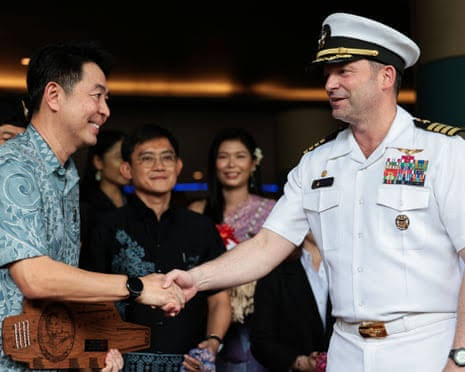
Shore leave in Pattaya, known for its red light district, comes after reports of deteriorating living conditions onboard the vessel during record stint

At Pattaya’s Hard Rock Cafe and hotel, the city’s mayor and police officials, along with women in traditional Thai dress, waited to greet the sailors who were arriving in civilian clothes, bags slung over their shoulders, off the buses.
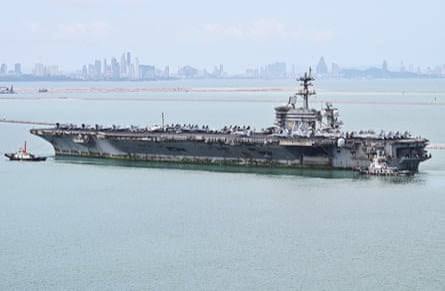
The USS Abraham Lincoln’s crew of 5,000 had not been on shore for nearly nine months, a record-setting uninterrupted time at sea.
Crew appeared to have been told not to speak to the gathered journalists about the reportedly deteriorating living conditions onboard but said they were looking forward to being on dry land, sleeping and going home.
One sailor, Breese, who did not want to give his surname, said “it’s a fever dream right now” and he was looking forward to trying Thai food for the first time and meeting new people.
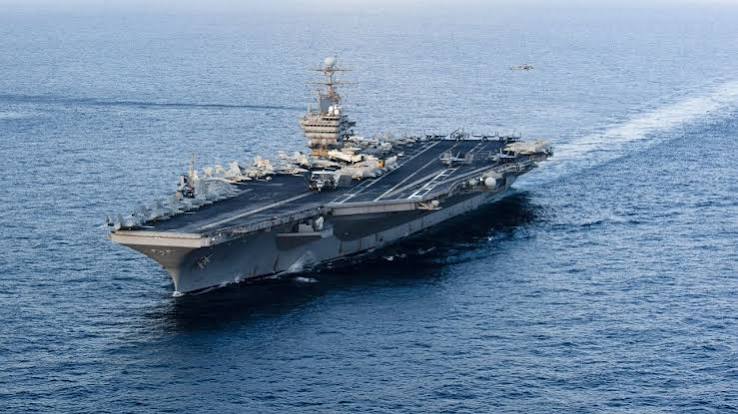
Once a quiet fishing village, Pattaya was transformed during the Vietnam war into one of the most infamous red light districts in the world with the arrival of American troops using military bases in Thailand.
At its peak, tens of thousands of US military personnel came through each year, said Pipatpong Fakfare, an associate professor specialising in tourism at Bangkok University. “In my opinion, it’s really the founding influence for the town. The US military turned a quiet fishing village into a global destination for an international nightlife and entertainment hub in about 15 years,” he said.
Although the American troops left by the mid-70s, the sex industry infrastructure continued to grow, with European tourists taking their place, and more recently waves of Chinese and Russian visitors, Pipatpong said.
The Hard Rock hotel is around the corner from the Soi 6 alley, known for its go-go bars, one of the many areas that contribute to Pattaya’s sex tourism industry. Soi 6 and the neighbouring area would be off-limits for crew after sunset, said Pattaya’s mayor, Poramet Ngampichet.
However, Walking Street, the town’s other entertainment and red light district, was displaying a massive neon sign at its entrance saying: “Pattaya City is pleased to welcome USS Abraham Lincoln carrier and its personnel.”
The sailors were being released in staggered groups, so not everyone was out. Shakeira Fairfax, who had travelled all the way from New Jersey, had to wait one more day to be reunited with her sailor daughter, Jada Fairfax.
Fairfax said she was mostly excited. “I just want to pick her up and spin her around. She’s my baby always,” but, she said, “I don’t know who I’m welcoming home.”
Jada finished her basic training last October and was shipped out a month later, two months before the US and Israel launched their war on Iran. Jada celebrated her 25th birthday onboard in June.
Fairfax said there was an “abrupt” stop to communication when the war broke out, but she had since been able to check in with her intermittently and send care packages.
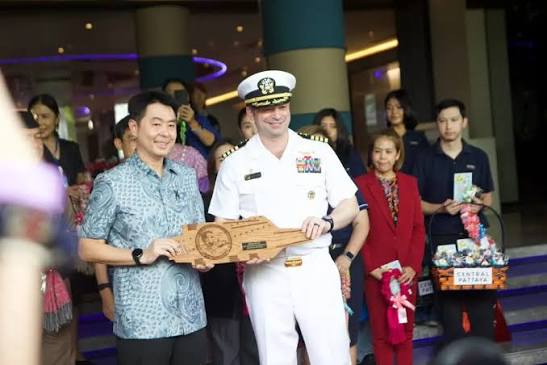
Keeler said there was plenty of food on the ship but admitted it became hard to get fresh fruit and vegetables, which stopped being served. “I am looking forward to a fresh salad.” They also had to be careful with supplies of soap and toothpaste to ensure every sailor could receive some, he added.
Asked about the reports of attempted suicides onboard the ship, Keeler did not answer, saying there was an open investigation. As for comments from Donald Trump, which included claims that the 270-day deployment was “not nearly long enough”, Keeler told the Guardian: “The president speaks for himself.”
Crew from the USS Higgins also arrived at the Hard Rock hotel. When asked about the conditions onboard the two vessels, Ethan Johnson, a cook on the Higgins, said: “We joined the military, it’s not a cruise ship.”
Johnson said there was plenty of meat and vegetables onboard the Higgins.
As well as being prohibited from entering certain areas, sailors are also being prevented from doing any water sports in the area, owing to the potential danger.
They will also not be allowed to visit pharmacies as Thai authorities do not want sailors accessing medicines that do not require a prescription in Thailand but may need a prescription in the US, Poramet said.
Kristopher Robinson, a naval attache with the US embassy, said Pattaya was chosen as the destination for rest and relaxation because the “people of Thailand have a history of being wonderful hosts not just to US sailors but people from all around”.
Robinson said the crew would take as much opportunity for rest as possible and conduct themselves in accordance with US and local laws. “Sailors here, like all tourists, they’re going to enjoy Pattaya’s great food and wonderful culture,” he said.
CREDIT: TheGuardian





Leave a Reply